Ivan Cheng
Oil Rig Elision (Tempesta d'amore)
10 August 2023 – 30 May 2024
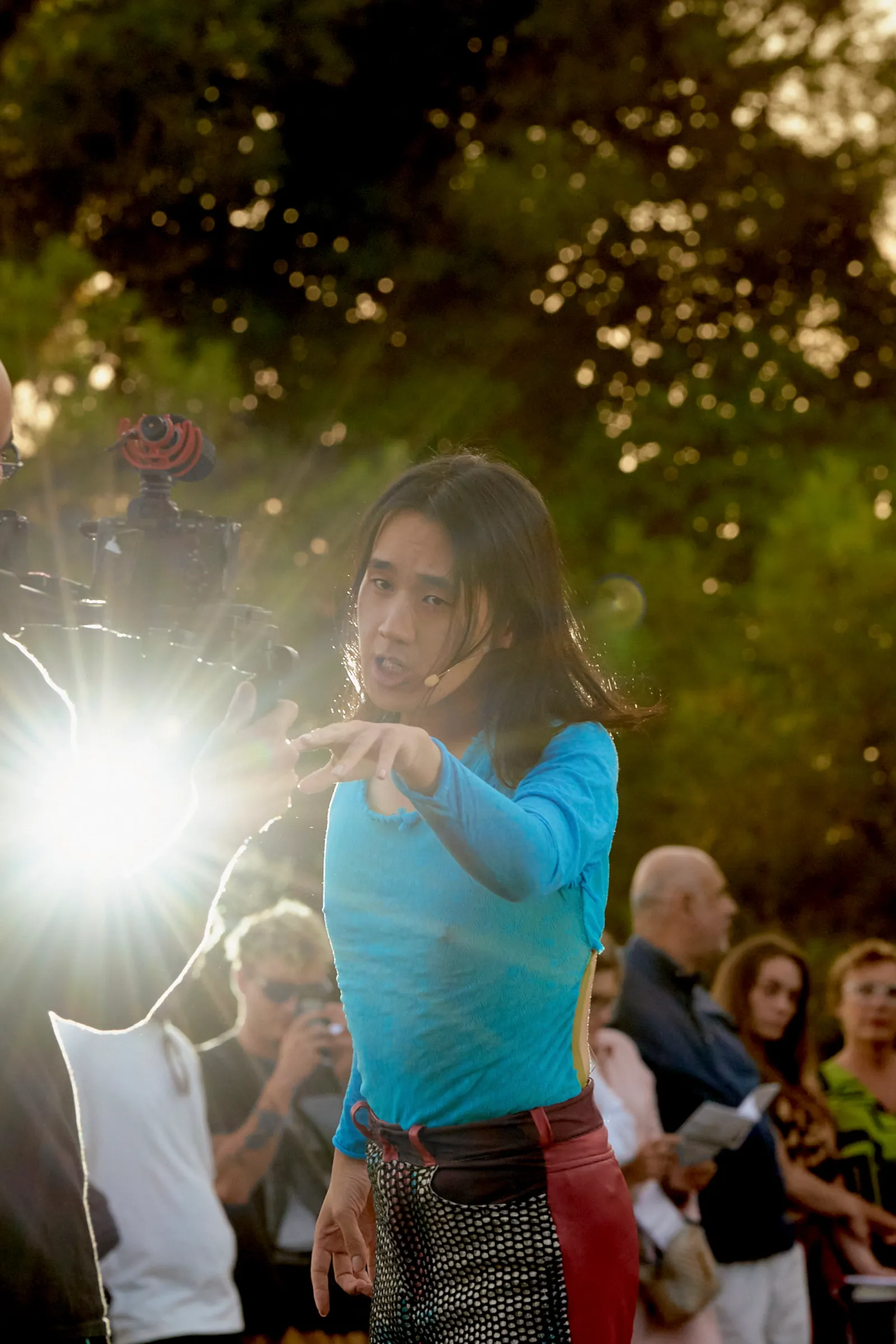
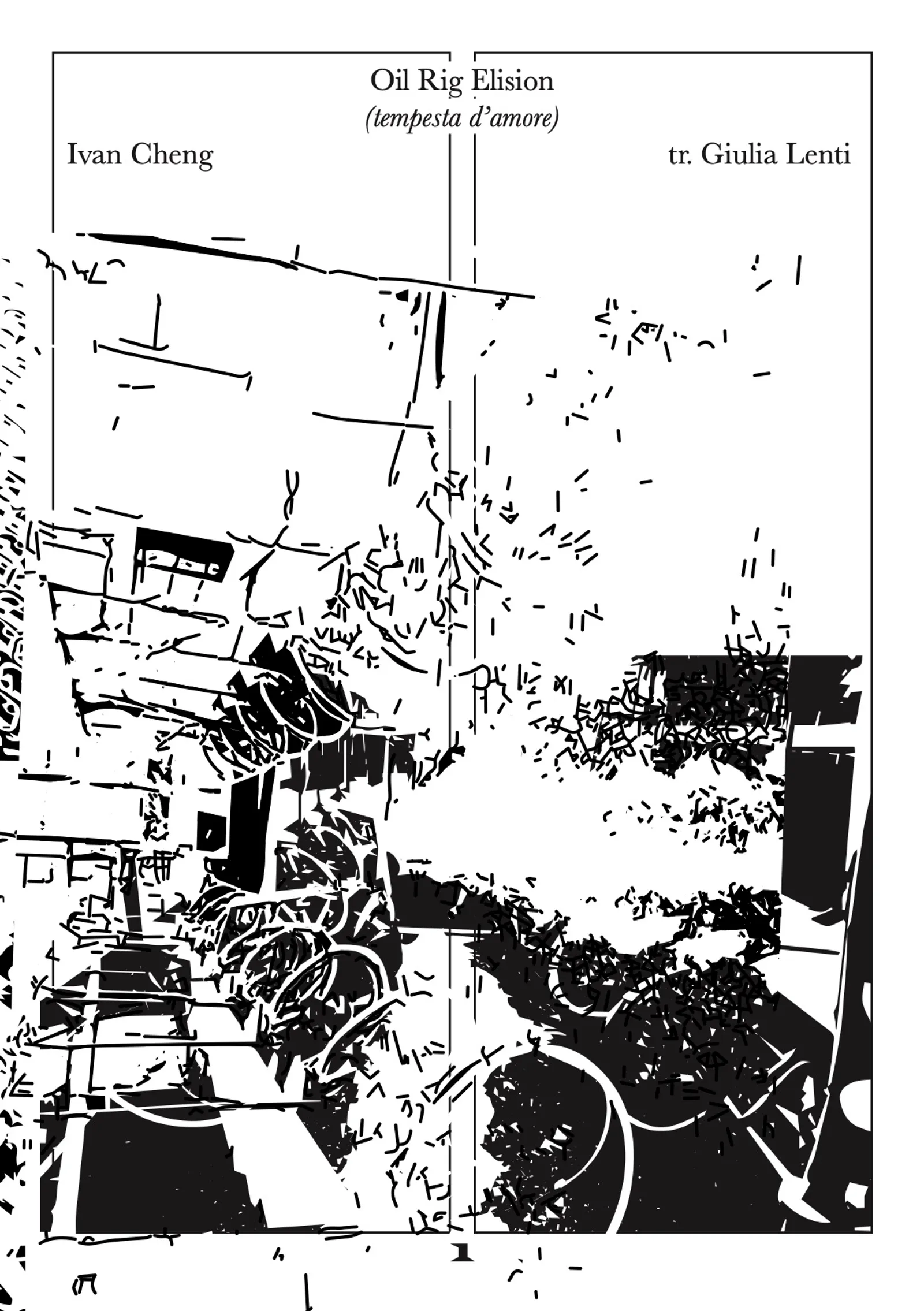
Oil Rig Elision (tempesta d’amore), 2023 is a performance by Ivan Cheng.
Oil Rig Elision (tempesta d’amore), 2024 is film by Ivan Cheng.
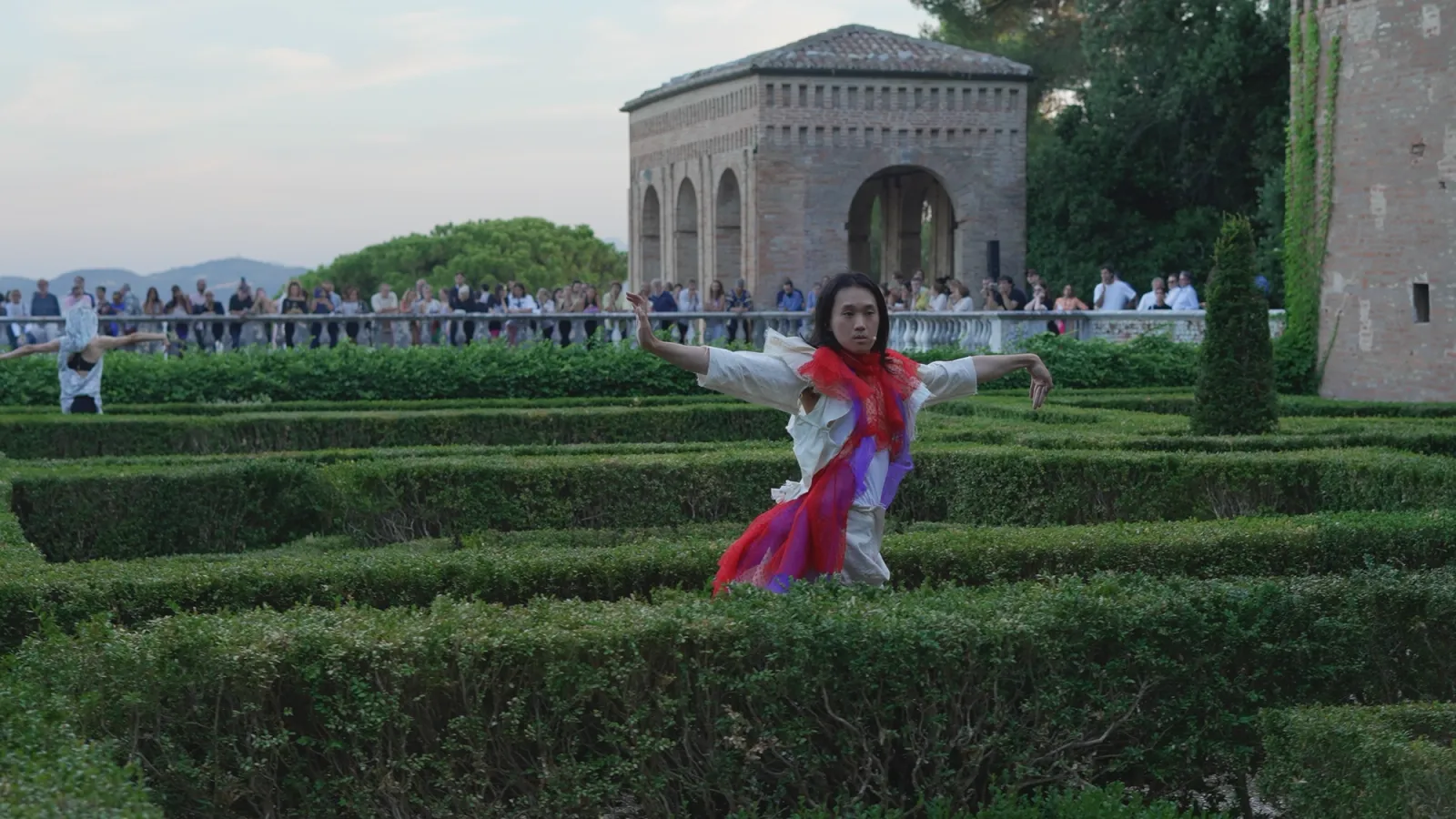
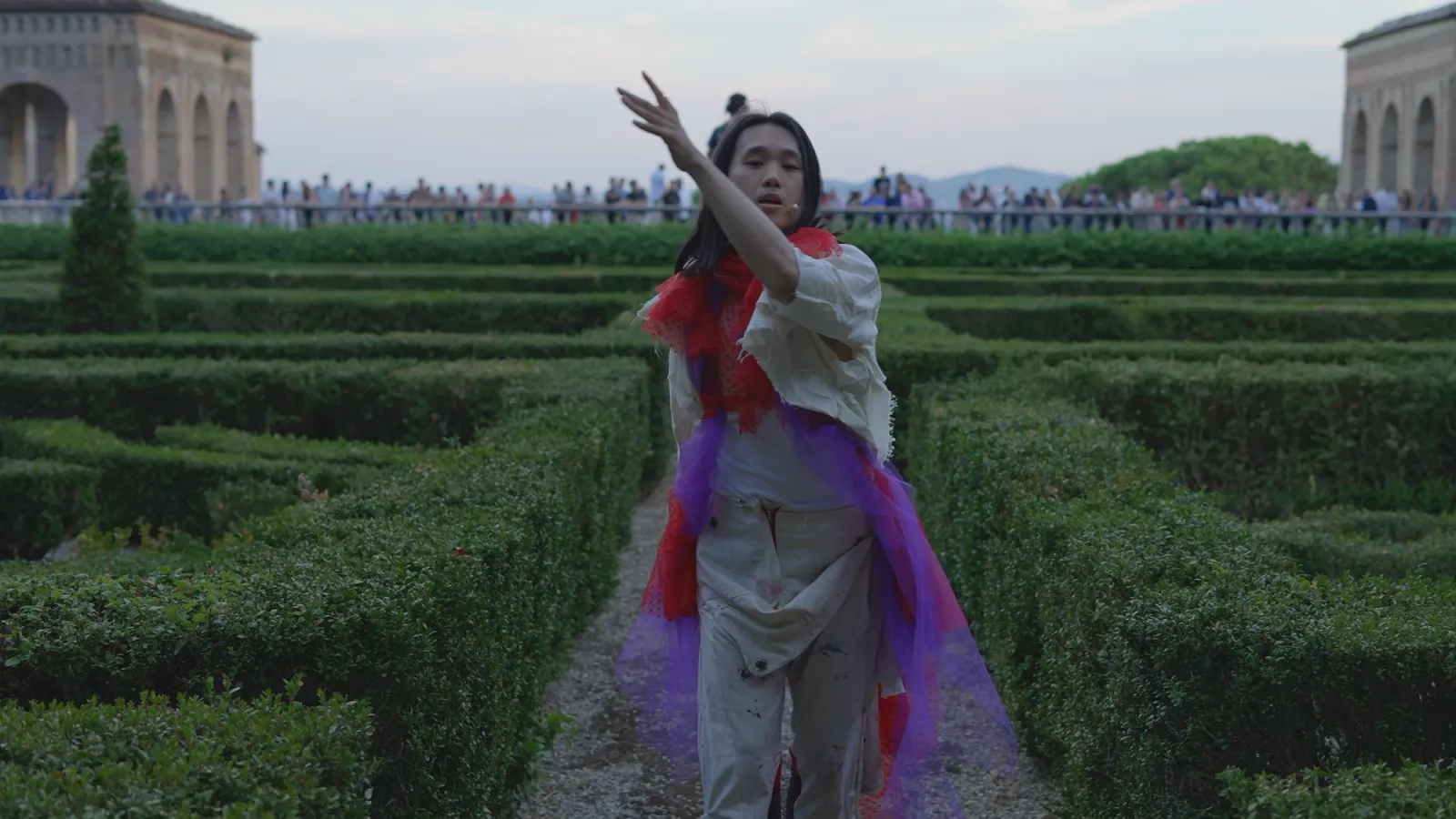
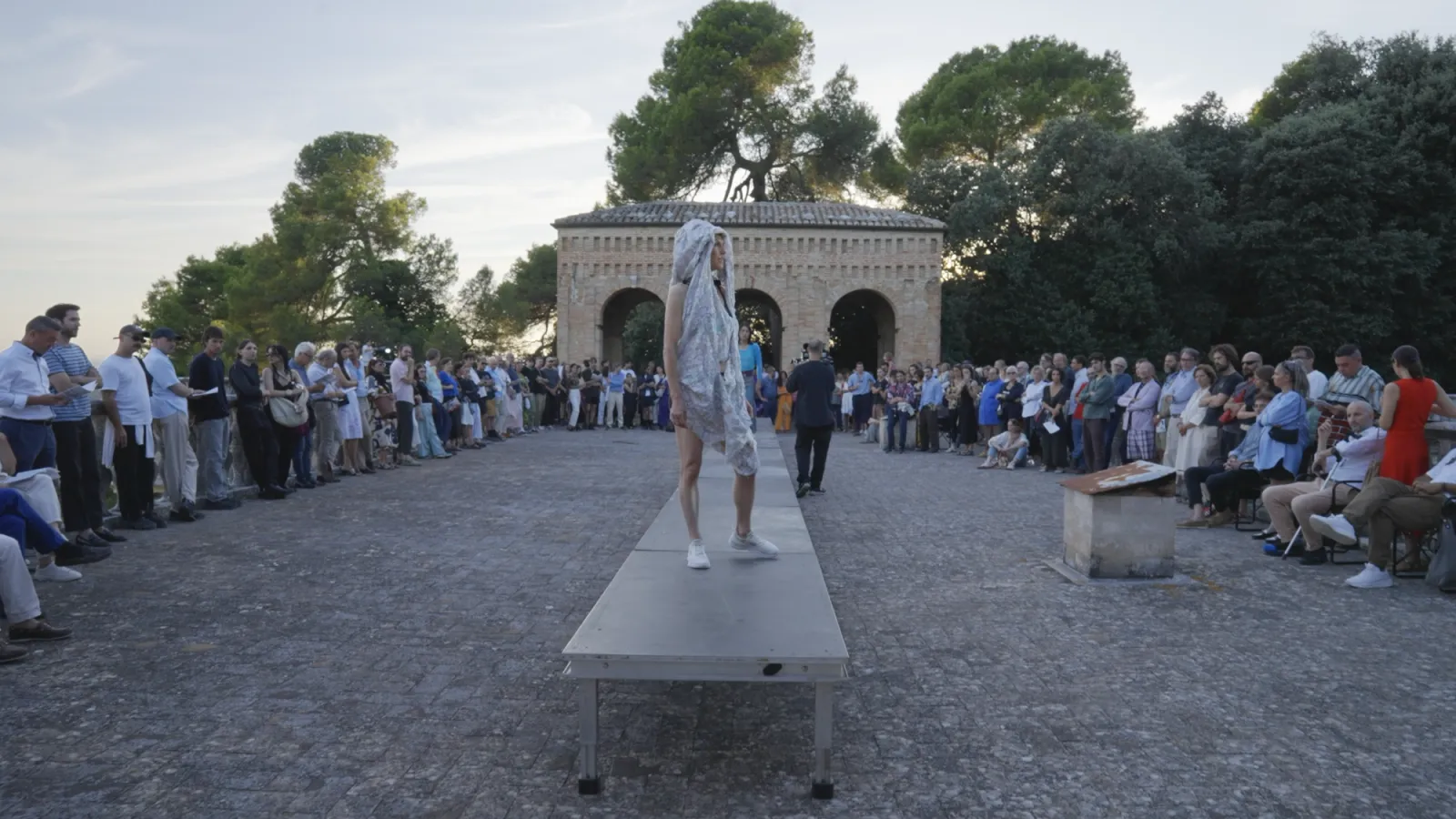
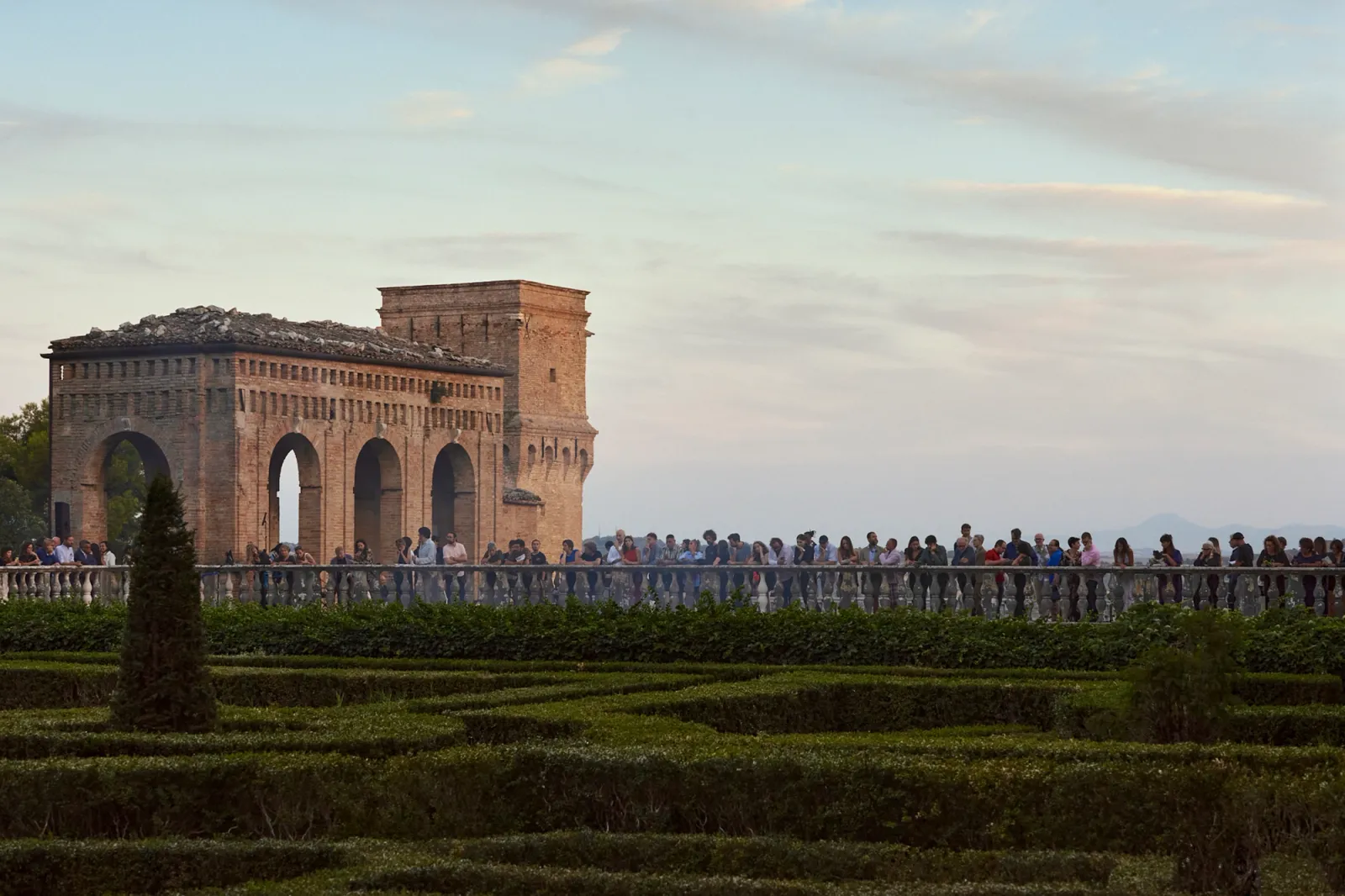
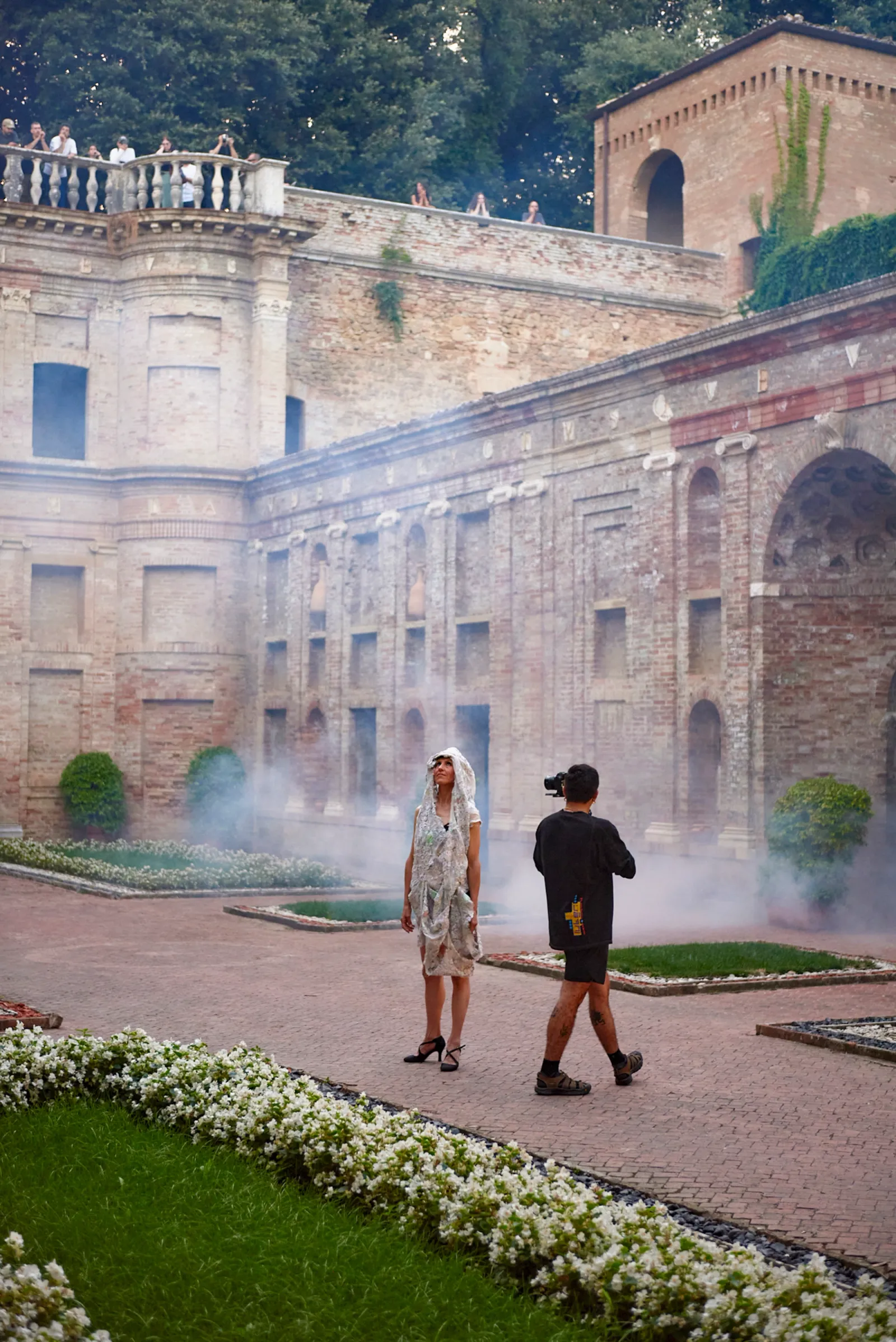
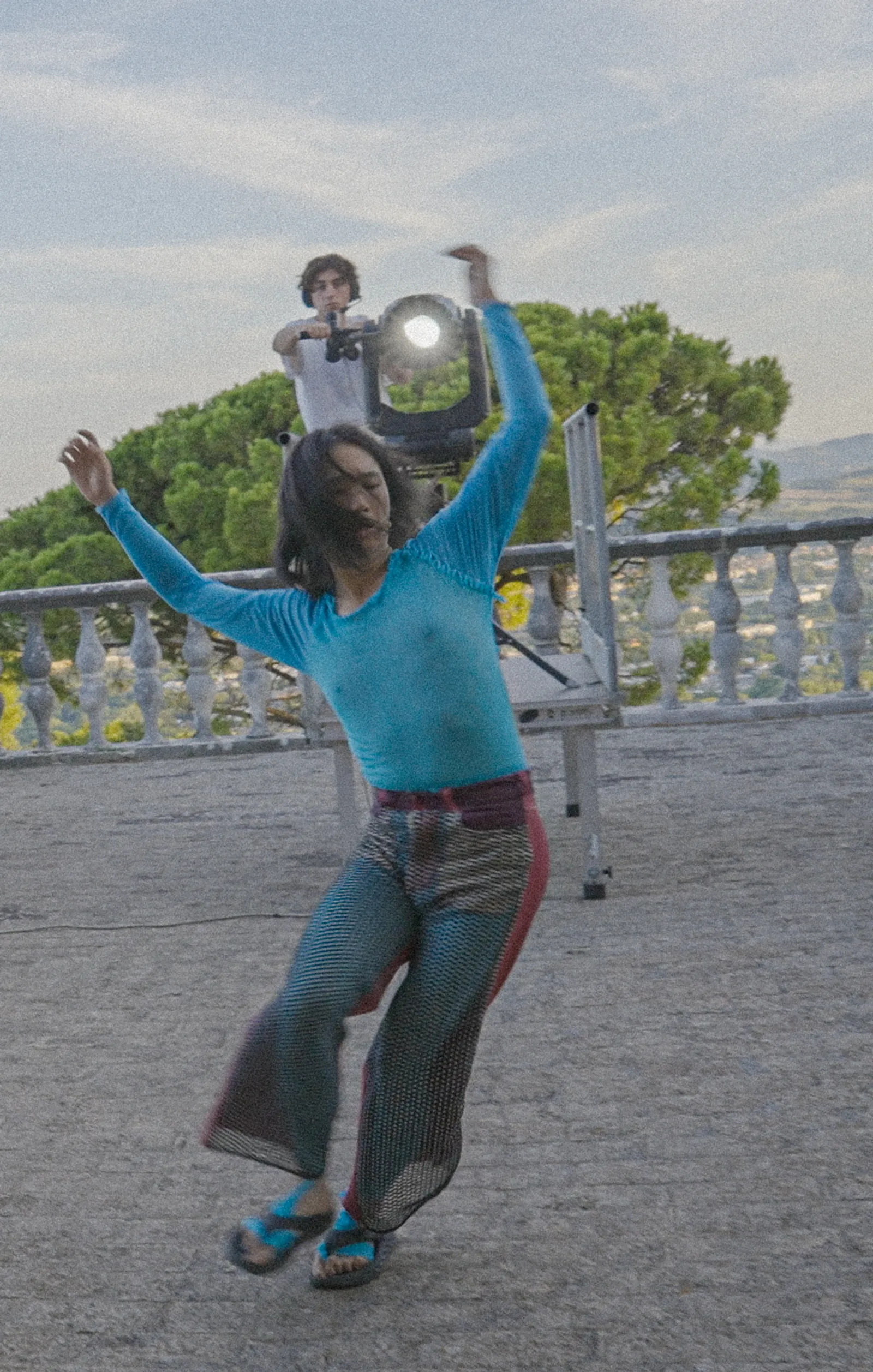
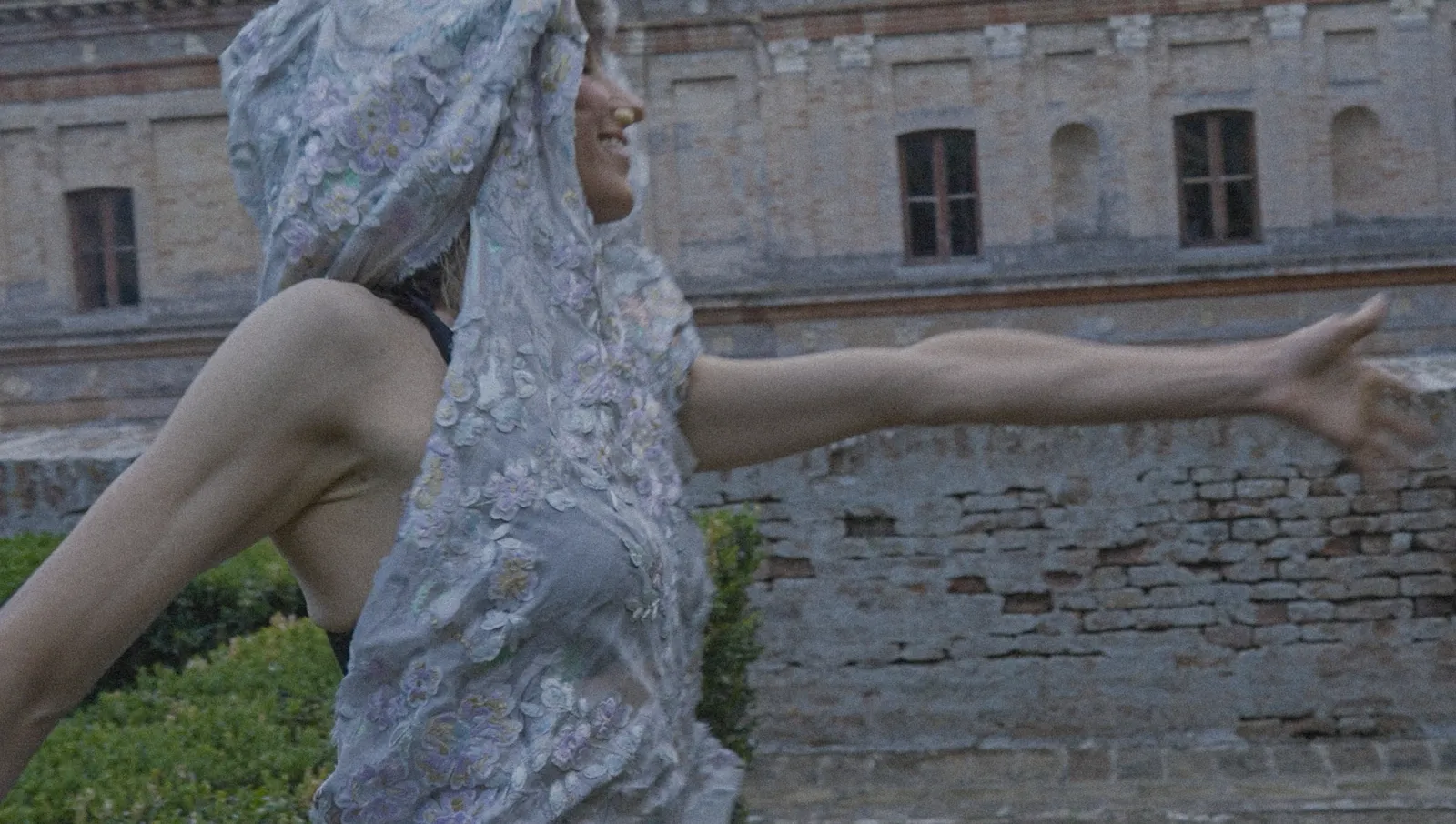
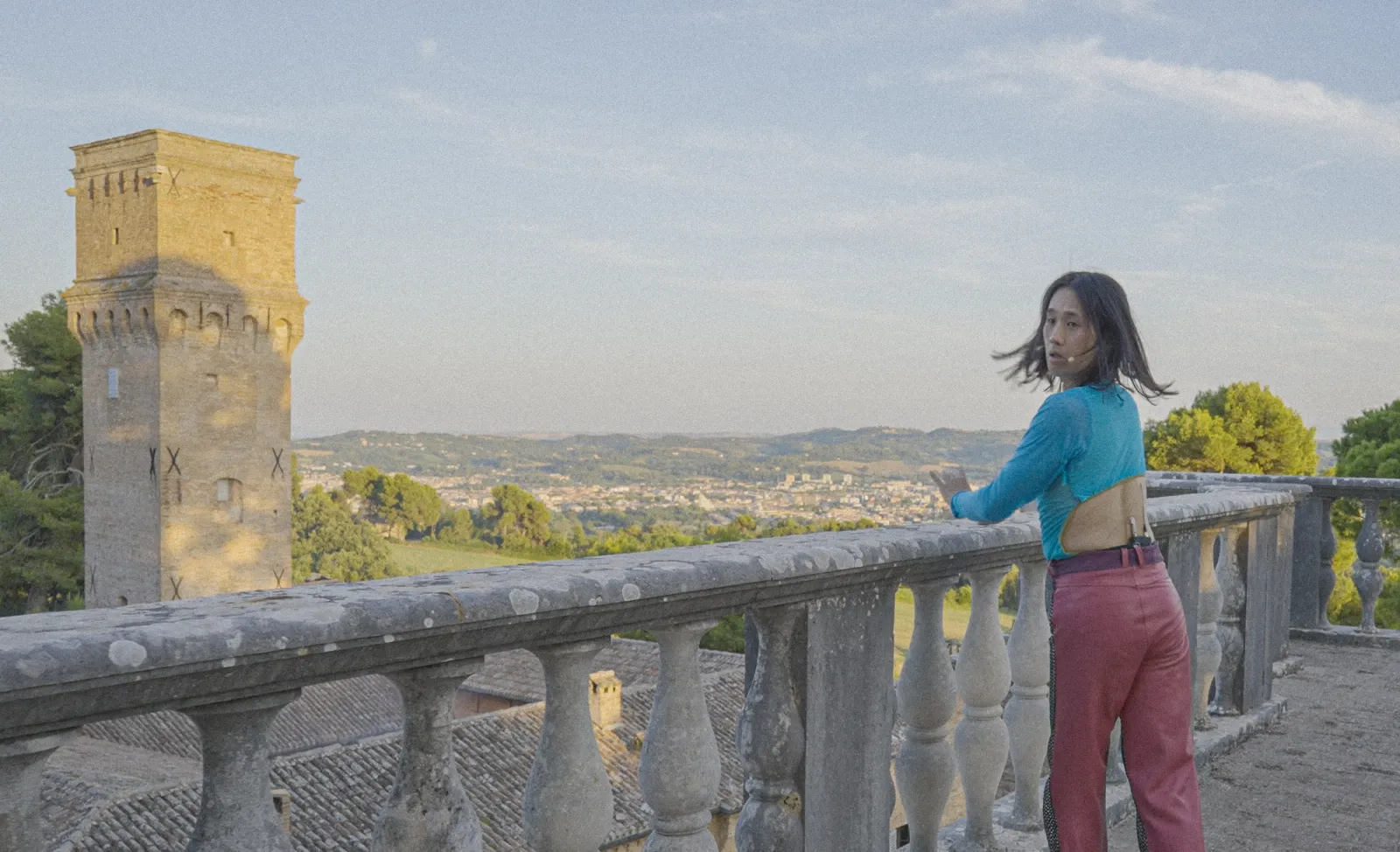
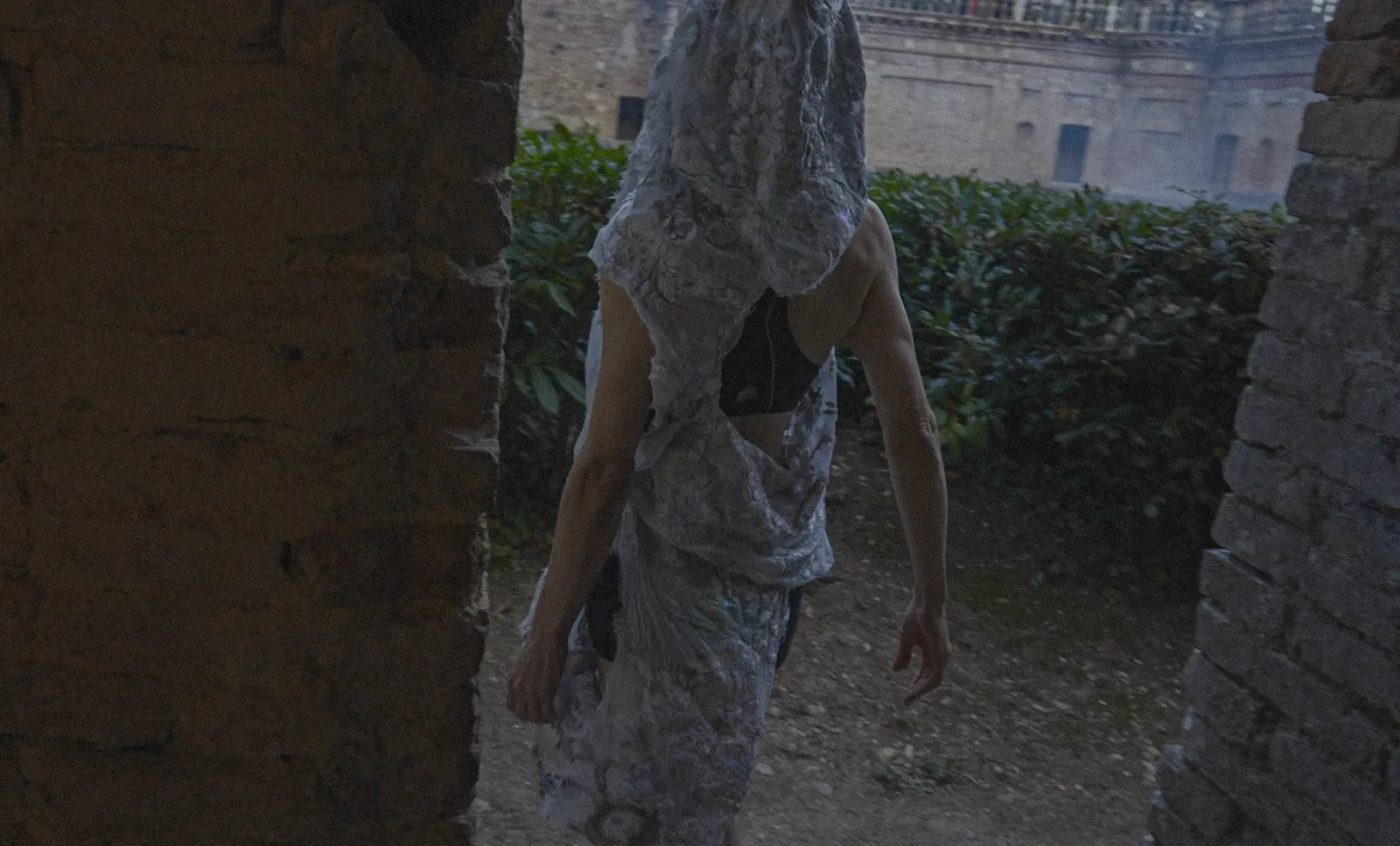
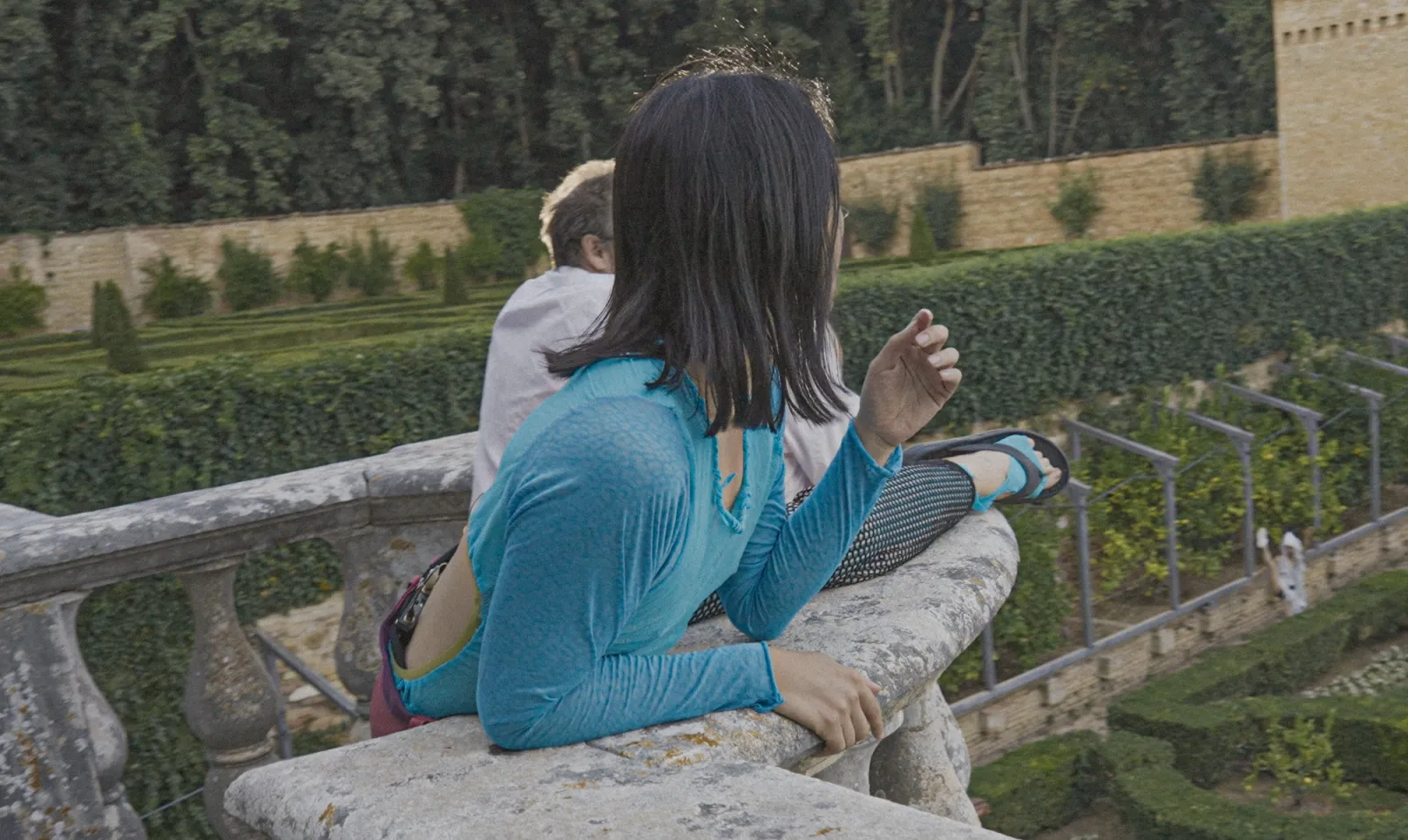
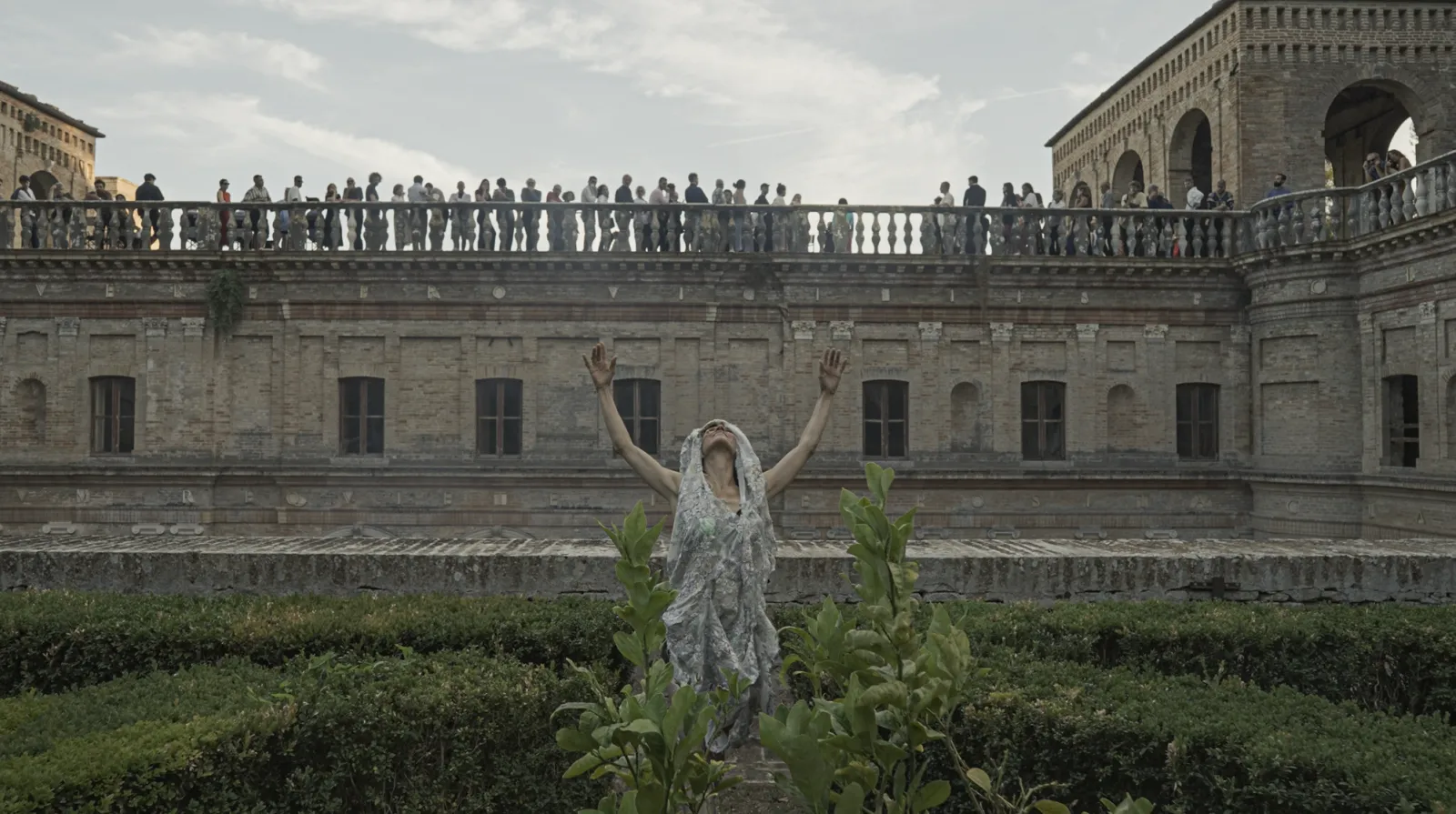
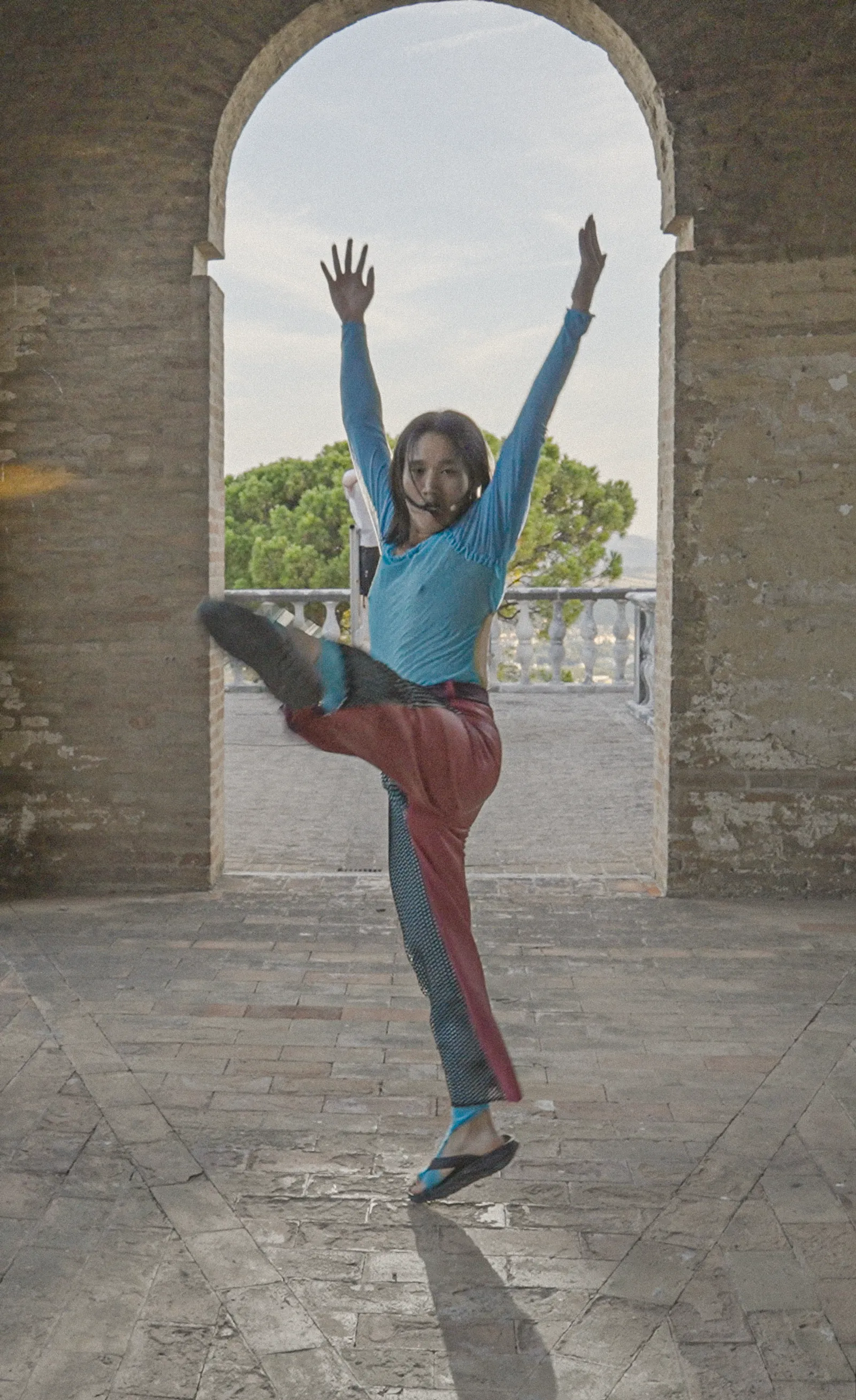
The film includes scenes filmed at Villa Imperiale (Pesaro, Italy) and scenes filmed during a public performance held on August 10th 2023 at the same location. Oil Rig Elision (tempesta d’amore), performance and film, both produced by INCURVA, were conceived in response to the curatorial concept Anti historia, drafted by Niccolò Gravina for Against Sun and Dust: Anti historia (2023).
A short essay by Niccolò Gravina, written in 2023.
Pasolini, in his unfinished novel Petrolio, wrote that there are people born with the vice of believing, to then question the political potential of art, by realising that one’s own work is but a game. The nullified reality is thus derided by those who undergo this awakening, to be then accepted again. Yet, any faith in history is lost, and the idea of hope in the future becomes irresistibly comical.
Ivan Cheng, who has always been uninterested in lying, implicit in each acting routine, has adapted his strategies of representation to the critical issues of an anti-historicist approach. Oil Rig Elision (tempesta d’amore) includes scenes filmed throughout the Villa Imperiale in the days preceding his public performance. His production thus insists on taking place elsewhere, in spatially autonomous situations, severed from the hierarchical gaze of historicism, made absent through a process of elision. The historical time is thus depicted by the depth of the spaces, as opposed to the univocity of the scene.
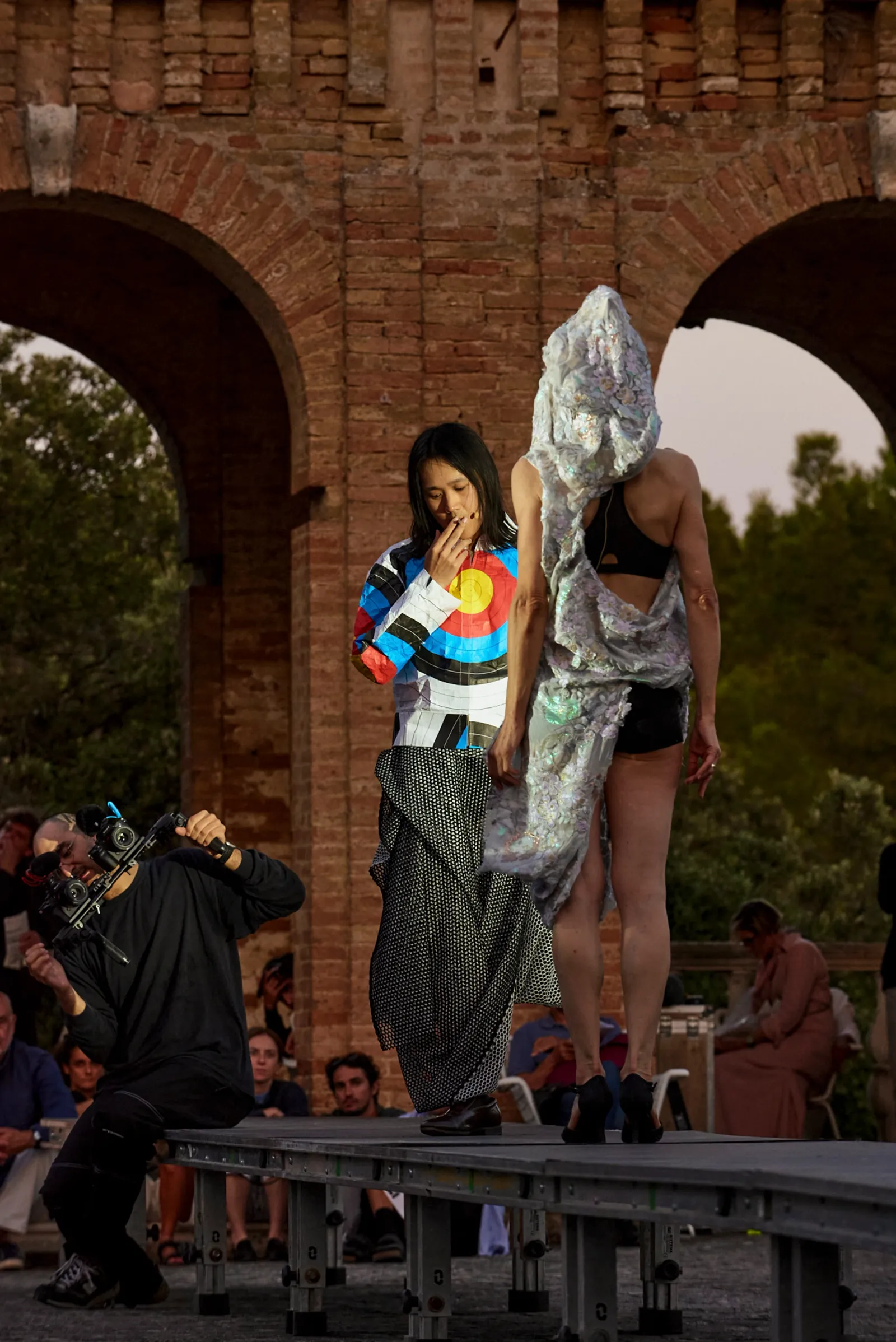
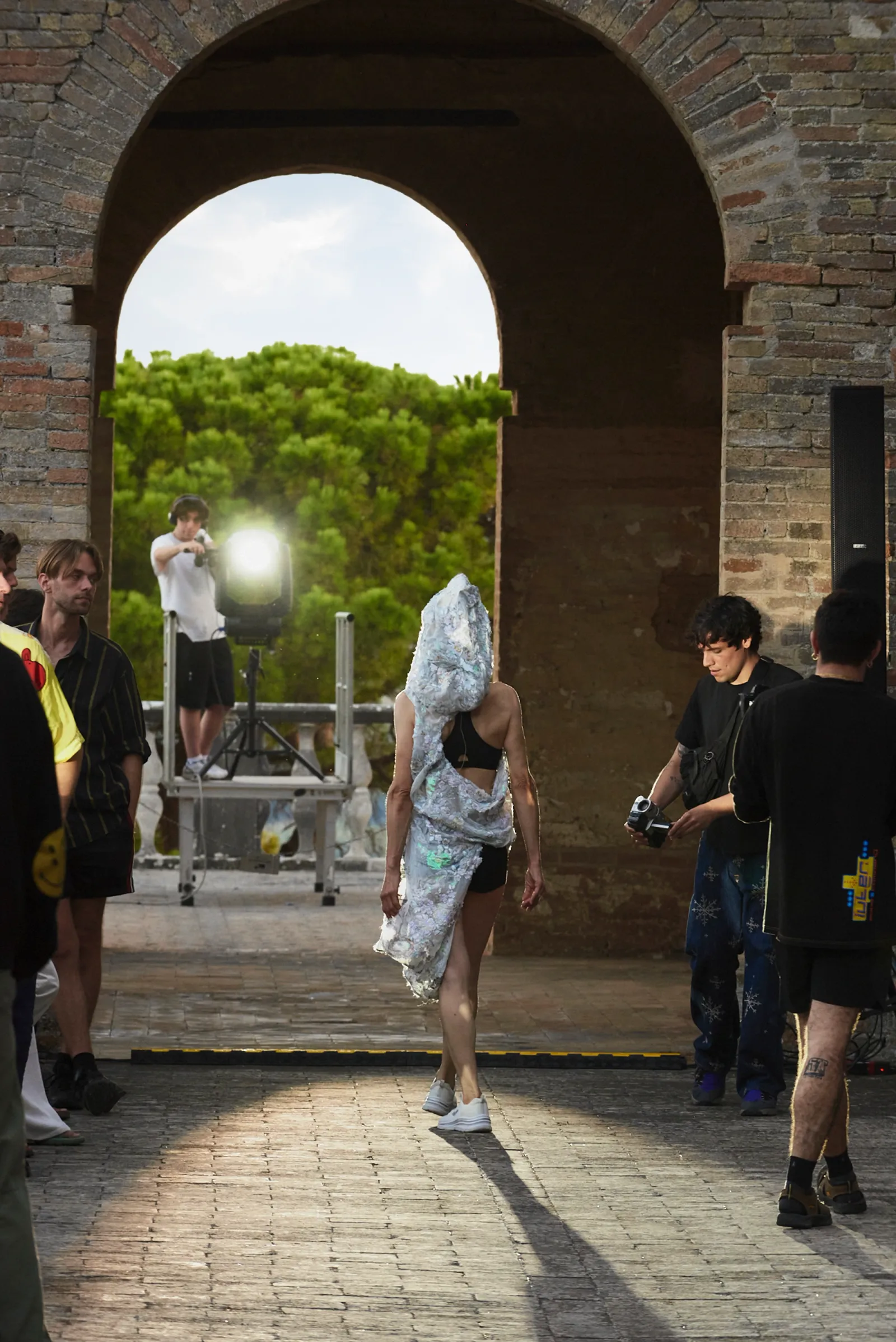
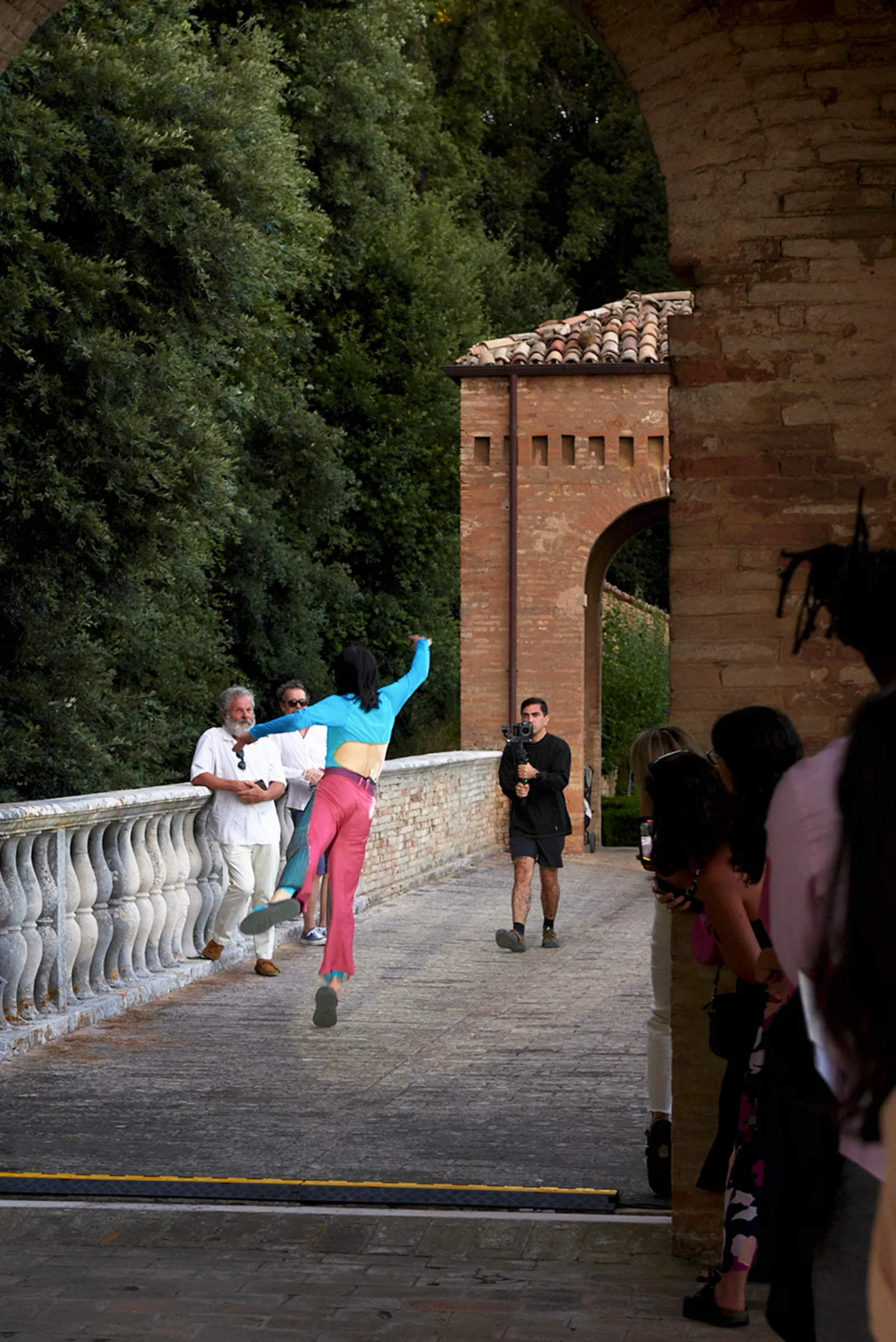
Evil twins to our eyes, the two cameras paired onto the rigs – supports custom-made to obtain stereoscopic imaging – degrade the sharpness of reality making it other, capturing repeated gestures and phrases, because memories are adulterated in their recollection.
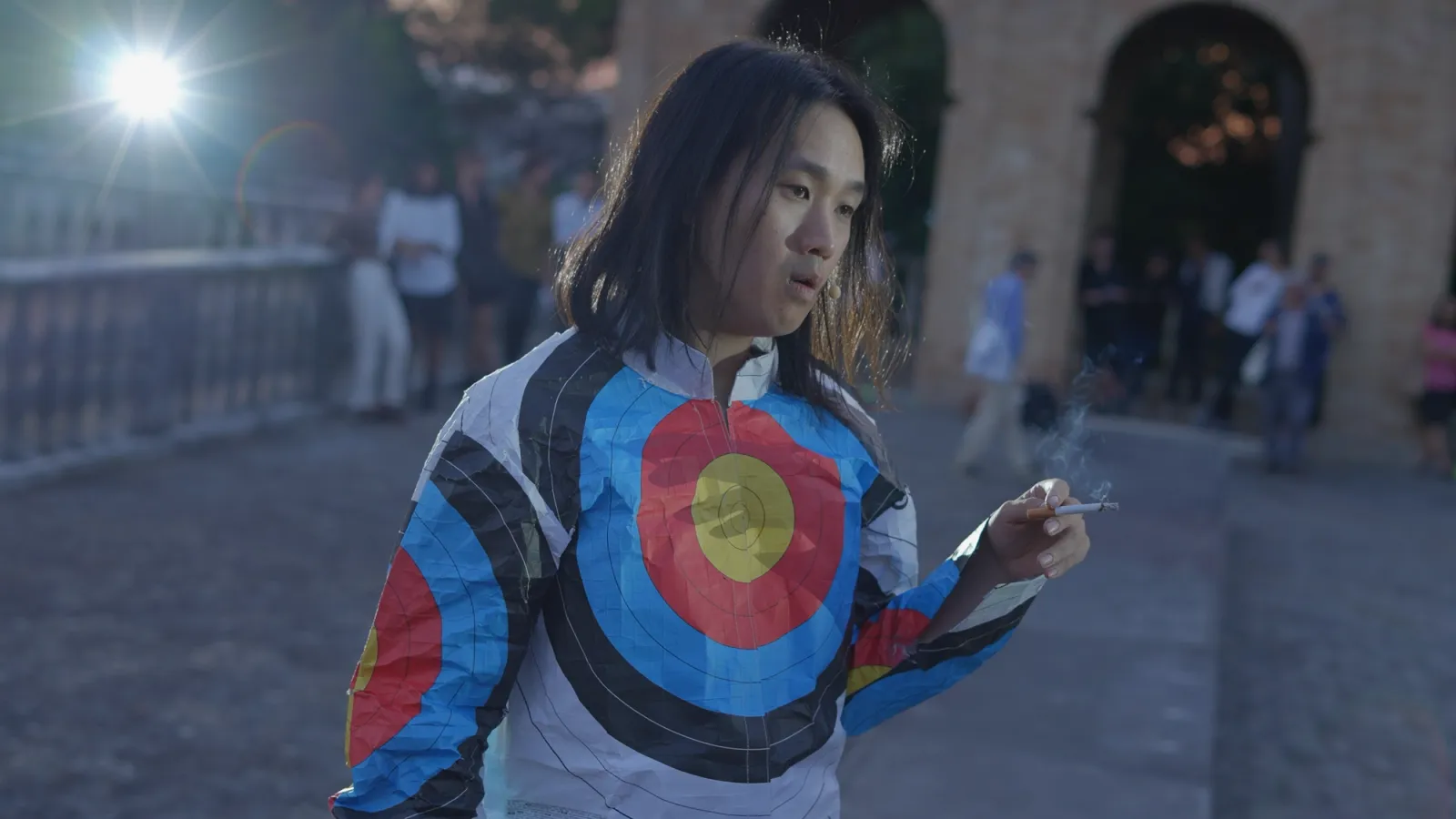
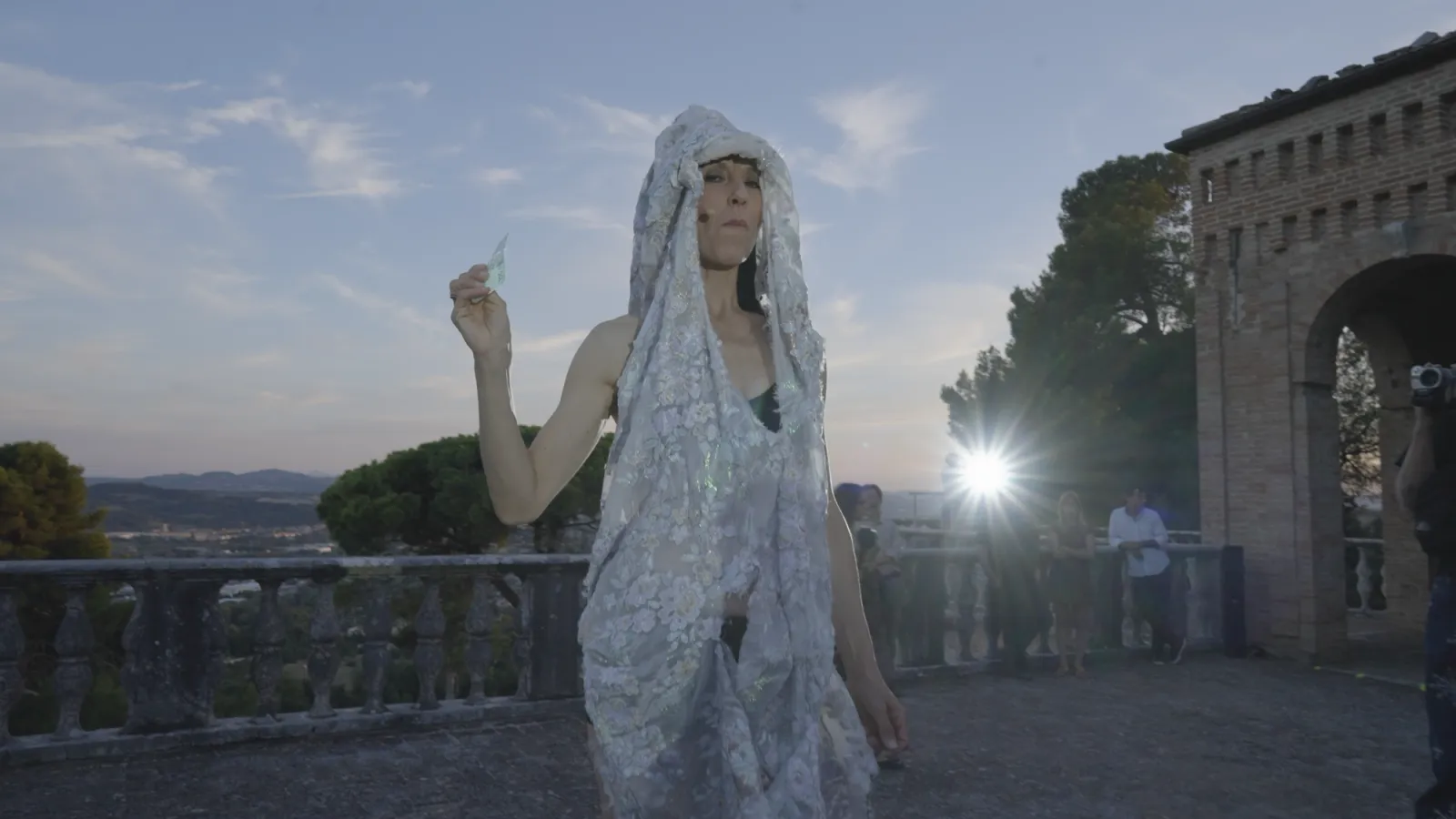
The relation between memory and identity then undergoes a crisis that involves the characters who have developed into archetypes, as if it were a soap opera; transcultural territories of accessibility, from which temporal coordinates are subtracted. Ivan’s subjectivity is diluted by his turning into a jesuit, virgin and ocean, while Patrizia, the dancer, is an oil tycoon and milkmaid. Eventually, the boundary between public, performer and technician fades away.
In Rossini’s and Vivaldi’s arias the character’s singing aims at elision, while in Rachmaninov’s piece it evokes the void of an expressiveness without language or history, virilely lean, femininely muscular in the acceptance of the emissions of the body.
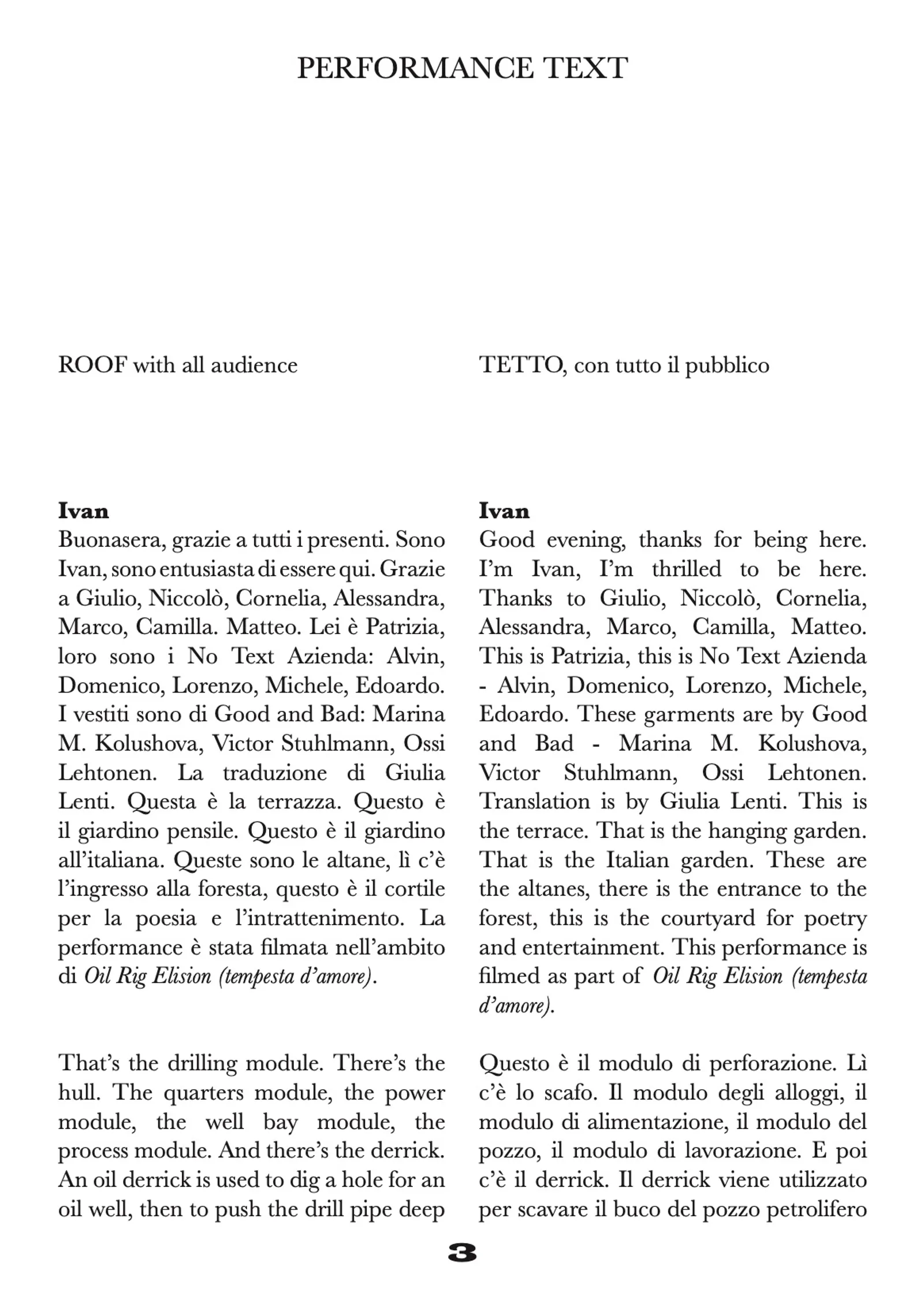
The performance itself has its start in the roveresco courtyard at dusk, to later see its developing within the various levels of the building, the hanging gardens, the Italian gardens and the terrace. Working with a camera team to suggest inscription of flatness, his written script finds anchor in the physicality of the context, the background and the people involved. The event invites the visitor choose one’s standing within the belief system imposed at Villa Imperiale, of the architecture transfigured into an oil rig, and bearing the title of a soap opera.
In the framework of Anti Historia memory is not to be understood as a stratification or repository of fixed entities, but rather as a stream of mnemonic events that rewrite the facts. To some extent, the process of inducing a memory is therefore natural.
Ivan Cheng approaches the architecture of Villa Imperiale (Pesaro, Italy) as a set piece and source for his reflection on the soap opera; working closely with No Text Azienda, he proposes a 3D video project with DIY double camera rigs. His production insists on taking place elsewhere, in spatially autonomous situations, severed from the hierarchical gaze of historicism, made absent through a process of elision. The relation between memory and identity then undergoes a crisis that involves the characters who have developed into archetypes, as if it were a soap opera. Ivan’s subjectivity is diluted by his turning into a jesuit, virgin and ocean, while Patrizia, the dancer, is an oil tycoon and milkmaid. Eventually, the boundary between public, performer and technician fades away.
Ivan Cheng, Oil Rig Elision (tempesta d’amore), 2024
Performers: Ivan Cheng, Patrizia Inzaghi, Giacomo Masini, No Text Azienda
Curator: Niccolò Gravina
Camera: No Text Azienda (Lorenzo Gentilini, Alvin Mojetta,
Domenico Nicoletti, Michele Zanotti)
Sound: A Teardrop Sound (Edoardo Rossano)
Garments: Good & Bad (Marina M. Kolushova, Victor Stuhlmann, Ossi Lehtonen)
Producer: Camilla Pagliano
Translation: Giulia Lenti
Produced by INCURVA
Conceived for Against Sun and Dust, Villa Imperiale, Pesaro, Aug 10, 2023
Special thanks to Cornelia Mattiacci / Il Teatro degli Artisti; Alessandra Castelbarco Albani,
Marco Di Nallo / Villa Imperiale.
© Ivan Cheng 2024
Courtesy the Artist and Edouard Montassut, Paris
Ivan Cheng, Oil Rig Elision (tempesta d’amore), 2023
Performed at Against Sun and Dust, Villa Imperiale, Pesaro, Aug 10, 2023
Performers: Ivan Cheng, Patrizia Inzaghi, No Text Azienda
Curator: Niccolò Gravina
Camera: No Text Azienda (Lorenzo Gentilini, Alvin Mojetta,
Domenico Nicoletti, Michele Zanotti)
Sound: A Teardrop Sound (Edoardo Rossano)
Garments: Good & Bad (Marina M. Kolushova, Victor Stuhlmann, Ossi Lehtonen)
Producer: Camilla Pagliano
Translation: Giulia Lenti
Produced by INCURVA
Courtesy the Artist and Edouard Montassut, Paris
Conceived for Against Sun and Dust, Villa Imperiale, Pesaro, Aug 10, 2023
Special thanks to Cornelia Mattiacci / Il Teatro degli Artisti; Alessandra Castelbarco Albani, Marco Di Nallo / Villa Imperiale.
The act of remembering implies the reconstruction and conformation of different fragments into a coherent narrative. Individual memory derives from processes of consolidation and updating; it should not be understood as a stratification or repository of fixed entities, but as a series, a stream of mnemonic events that rewrite the facts. To some extent, the process of inducing a memory is therefore natural.
The conflict between the complexity of individual memory processes and collective narratives can be an opportunity for new experimentations on the notion of historiography, which constitutes the subject of the fourth edition of Against Sun and Dust: Anti Historia .
Conceiving history as a systematic statement of past human facts and events, arising from a critical investigation that defines their mutual connections, implies its strangeness to the living. The actuality of our actions, although programmable in the future or understandable in retrospect, is, by definition, unthinkable in the present; a void of consciousness is necessary to act.
In contrast, Against Sun and Dust is a paradoxical attempt to make history and life coincide in a sequence of events of a day in August, virtually superimposing the memory of the villa on the simultaneous perceptions of visitors. This attempt is a way to undermine the tendency to the univocity of historical restitution, resulting in the ouster of other latent interpretations that belong more to the disorder of individual perception rather than the logic of collective narratives.
Against Sun and Dust was conceived to bring to light the hidden virtualities and potentialities of Villa Imperiale: unveiling its dense spatial stratigraphy and intersecting eras lesser known than the established Renaissance identity; analysing the implications of the route on the perceptions and the evolving reconstruction of fragmented landscapes; reactivating the latent potentialities of scenic spaces; and dissecting it to reveal the private functional sides and secret infrastructures designed for humans and water.
In this sense, the theme of anti-historicism intended as the recovery of virtualities is a perpetuation or deepening of a sensibility that has guided past editions.
Further analyzing the history of Villa Imperiale, we will focus on the difficulties of reconstructions, methodological uncertainties, errors and mythologies that can generate creative and expressive energy. Starting from these critical issues, symptoms of the irreducibility of perceptions to the structures of discourse, artists are invited to force their languages and expressive methods in relation to the history of the architectural complex.
If history exerts a fascination, this lies not in the orderly reconstruction of facts, but in the temporal abyss perceived in the physical encounter with material, artistic, and architectural evidence. This vertigo, unmeasurable by definition, is at the heart of this edition, beyond the critical analysis implemented by the historical reconstruction.
This attraction is accompanied by an inevitable political tension, inherent to the power of dominant historical reconstructions. The intention is not to undermine the importance of reflections on historical-political context, which are necessary for understanding the phenomena of human life — including artistic ones — but to bring to light potentialities excluded from current perspectives.
At the same time, we want to move away from current forms of historical revision. If revisionism is the denial and replacement of one narrative with another, anti-historicist sensibility aims at undermining the narrative itself.
Anti Historia is the will to disorient the solemnity of historical reconstruction, to unveil the paradoxes and contradictions from which the desire to express oneself arises.
Niccolò Gravina
Within 1572 and 1574, author Ludovico Agostini chronicled a day he spent at the Villa Imperiale in Pesaro (Italy). Duke Francesco Maria II Della Rovere and his court took Agostini through a day of conversations, music and poetry performances, from dawn to dusk. With a modern perspective, the author described in detail the path to the Villa, including the palace, grotto, hanging gardens, and surrounding woods, all with views of the Adriatic Sea and the Apennines. Agostini’s narrative serves as one of the inspirations for the Against Sun and Dust project. Against Sun and Dust since 2020 provides access to previously undiscovered parts of Villa Imperiale and its woods, offering a unique setting for interdisciplinary experimentation. Locations and paths change annually, allowing visitors to explore new rooms and areas.
Against Sun and Dust is conceived by Cornelia Mattiacci (Rome, 1985) and Alessandra Castelbarco Albani (Basel, 1983)
In 2023, the curatorial concept was Anti Historia and the following artists were invited to respond to it:
Ivan Cheng, produced by INCURVA, curated by Niccolò Gravina
Stuart Middleton, curated by Attilia Fattori Franchini
PLO man, curated by Ruggero Pietromarchi